Something that is one of the zanier things I've done is chosen to speak to my kids in Hebrew despite it not being my native language. I don't know some words, my grammar (though improved) is nowhere near perfect, my accent is atrocious, I don't use idiomatic expressions, I speak very slowly, and have trouble conveying sophisticated concepts to them. They have difficulty understanding Israelis.
On the plus side, they are all comfortable with basic Hebrew. They will probably easily be able to speak in Israel. My older two are comfortable in Israel and understand it (though my oldest hesitates to speak). When they start Chumash, they are familiar with a great deal of the words. They have a fairly decent basic Hebrew vocabulary that they learned with no pain.
My three little ones can barely read Hebrew yet, so they haven't started skills work inside. We will see how that emerges. They are 6th, 4th, and 2nd grade. My 4th grader has expressed an interest so I hope to try to get started with him.
My second child is something of a polyglot. She asked for Japanese lessons, which I acquired for her via skype for 3 years, then she asked me to buy her a Japanese textbook, which I did, and then she traveled to Japan twice. She took a college course in Russian (got an A, her first college course), and she is teaching herself Dutch.
My oldest (married already) started teaching herself Korean using dualingo and seems to be getting fairly fluent.
I've always kind of wondered how Hebrew language unschooling could work. Bear in mind that it might work "better" in the case I'm describing because this child has a natural aptitude for and enjoyment of languages.
We put Hebrew font on all of her devices and I text and chat in Hebrew as much as possible.
I bought her Harry Potter in Hebrew at her request and I bought her R' Winder workbooks for older kids at her request. To my knowledge she has not used them whatsoever.
I did read about some book which was supposed to be AMAZING about acquiring language by an opera singer who needed to learn German and Italian for operas or something like that. I bought her the book and she did read a lot of it and said it was incredibly helpful.
She went to a Zionist camp with actual Israelis and she joined their whatsapp group and they were thrilled that she can communicate in Hebrew.
She started translating songs they shared with her. Many times a day she asks me what phrases mean.
She joined something called discord which has sections for all sorts of interests and went into the languages section and into the Hebrew section and is chatting with people there.
What is interesting from the standpoint of unschooling is that language acquisition looks NOTHING like it does in an academic setting. You can be "behind" for years and then quickly spend hours and months on it and acquire tremendous skills. The acquisition is fun and exciting. There is a risk it will not be acquired to the level the parent would wish for. But in unschooling, we have trust that knowledge is fun and useful and able to be acquired at any time, at any age, as needed or wanted.
Showing posts with label ivrit. Show all posts
Showing posts with label ivrit. Show all posts
Monday, August 27, 2018

Tuesday, December 22, 2015
the tablet, rewarding for reading, and unschooling Hebrew reading
So Elazar just came over to me and asked me to do another line of Shema so that he can earn another hour of tablet. He's only played on it for a few hours and he mentioned that it's already getting a bit boring because all the great games he was anticipating playing only have a few levels for free and it turns out he'll need to spend more money. He also was quite upset about having to earn it for a Siyum when he is paying for it with his own money. He brought up "Ploni Almoni" whose mother bought him a tablet AND gave it to him for nothing. I valiantly tried to hold off but eventually the words "every family has different rules" and "when you are grown up you will make the rules for your household" came out of my mouth.
So as he is reading through his line in Shema, I started thinking about unschooling reading again. It was an excruciating 5 minutes. He is improving, he is remembering the letters and nekudos better, he's blending beautifully, etc.
As I look back at my blog posts about reading Hebrew, I hilariously discover that I have this same question every year at about this time. Two years ago, Elazar learned the nekudos ridiculously quickly and efficiently. I am just about positive (scary scary scary unschooling!) that he will learn to read Hebrew fluently in about a week when he wants to. So why am I hocking him? Why am I nudging a reluctant organism to do things his brain doesn't really want to do, when if I leave it alone, he will do it with joy and alacrity and it will take him a fraction of the time?
So as he is reading through his line in Shema, I started thinking about unschooling reading again. It was an excruciating 5 minutes. He is improving, he is remembering the letters and nekudos better, he's blending beautifully, etc.
As I look back at my blog posts about reading Hebrew, I hilariously discover that I have this same question every year at about this time. Two years ago, Elazar learned the nekudos ridiculously quickly and efficiently. I am just about positive (scary scary scary unschooling!) that he will learn to read Hebrew fluently in about a week when he wants to. So why am I hocking him? Why am I nudging a reluctant organism to do things his brain doesn't really want to do, when if I leave it alone, he will do it with joy and alacrity and it will take him a fraction of the time?
Tuesday, November 18, 2014
al pi darko if you're ADHD
Elazar was determined to keep learning to read Ivrit. He brought me the aleph bina and spent between 45 minutes to an hour finishing all the nekudos with the aleph beis (the next section is each letter of the aleph beis with different nekudos). I personally was getting bored already but he didn't want to stop.
He got restless but he insisted on continuing. He ended up reading while climbing on top of me.
 Note that he's blurry because he's moving.
This happened between 5:15 and 6:15pm, known in many households as an unpleasant time of day. The boys had already made themselves pita pizzas at about 4:30, according to their hunger, and Elazar asked to work. Jack was so jealous that he first kept sitting on my lap and blocking Elazar. I tried to give him lots of hugs while still allowing Elazar access to read what he was trying to read. Eventually he ran off (after shutting the light so Elazar and I couldn't see, and then turning it back on when I told him to) and grabbed a workbook (one of the ones I was thinking about passing along because no one ever touches it) and one of the neighbor kids, who is 6, was helping him write and coaching him how to do it. So both boys were diligently working.
He got restless but he insisted on continuing. He ended up reading while climbing on top of me.
This happened between 5:15 and 6:15pm, known in many households as an unpleasant time of day. The boys had already made themselves pita pizzas at about 4:30, according to their hunger, and Elazar asked to work. Jack was so jealous that he first kept sitting on my lap and blocking Elazar. I tried to give him lots of hugs while still allowing Elazar access to read what he was trying to read. Eventually he ran off (after shutting the light so Elazar and I couldn't see, and then turning it back on when I told him to) and grabbed a workbook (one of the ones I was thinking about passing along because no one ever touches it) and one of the neighbor kids, who is 6, was helping him write and coaching him how to do it. So both boys were diligently working.
Monday, October 13, 2014
Succos
It's chol hamoed and Chana mostly works at night so after the boys have been going to bed, we've been doing some algebra (about 15 minutes worth) and yesterday we did Chumash and Rashi. It's the end of a long day and I don't look forward to dredging through the skills work. (Mostly it's the Rashis; the pesukim go pretty quickly.)
Yesterday I was reading a lookjed digest and I saw there are online course offerings in Nach. They have for grades 8-9, and grades 10-11, I forget the exact grade breakdown. I perked up when I saw 8th grade and looked at what was being offered for Chana's grade level. There were two Melachim courses, the first half and the second half of Melachim I, and there was a course on Eliyahu. I was thinking about looking into it more, and how exciting it is, and then I was thinking about how I could actually do this with Chana myself instead of registering her.
Which got me thinking about how many things I've wanted to do as a homeschooler over the years vs. what actually gets done. I'm sure there are homeschoolers out there who have an 8th grader (or any other graders) and actually get through a schedule, and have regular Nach sessions. In choosing the unschooling route, our lives don't take that path. I'm comfortable with the science and social studies and halacha that comes up that way. But occasionally I have twinges. I imagine starting school at 9am and going til 3, with an hour for lunch and maybe a 15 minute break in the morning. And we learn academics. I imagine how much Chana would learn if we did that.
Then I think about all the things she does with her time that she wouldn't get to do if I structured her time that way. And all the things she learns.
I figure one of these days I'll sit down with her and confirm that she knows basic conjugation of Hebrew tenses, past, present and future. That probably won't take very long. And this evening, after algebra, I said let's do Chumash, and she sighed, and I asked her if she wanted to do Nach instead. She eagerly sat down and we delved into Dovid Hamelech. It was a lovely chol hamoed treat.
Yesterday I was reading a lookjed digest and I saw there are online course offerings in Nach. They have for grades 8-9, and grades 10-11, I forget the exact grade breakdown. I perked up when I saw 8th grade and looked at what was being offered for Chana's grade level. There were two Melachim courses, the first half and the second half of Melachim I, and there was a course on Eliyahu. I was thinking about looking into it more, and how exciting it is, and then I was thinking about how I could actually do this with Chana myself instead of registering her.
Which got me thinking about how many things I've wanted to do as a homeschooler over the years vs. what actually gets done. I'm sure there are homeschoolers out there who have an 8th grader (or any other graders) and actually get through a schedule, and have regular Nach sessions. In choosing the unschooling route, our lives don't take that path. I'm comfortable with the science and social studies and halacha that comes up that way. But occasionally I have twinges. I imagine starting school at 9am and going til 3, with an hour for lunch and maybe a 15 minute break in the morning. And we learn academics. I imagine how much Chana would learn if we did that.
Then I think about all the things she does with her time that she wouldn't get to do if I structured her time that way. And all the things she learns.
I figure one of these days I'll sit down with her and confirm that she knows basic conjugation of Hebrew tenses, past, present and future. That probably won't take very long. And this evening, after algebra, I said let's do Chumash, and she sighed, and I asked her if she wanted to do Nach instead. She eagerly sat down and we delved into Dovid Hamelech. It was a lovely chol hamoed treat.
Friday, August 22, 2014
fretting
I woke up this morning fretting about Chana. We are spending the week with my parents and we forgot her Chumash. I was planning to do Chumash and math with her yesterday but we didn't get to it. It's not such a big deal to have a week off. But this morning, my brain was worrying. First I was thinking about algebra. Things are still under control to have her take the regents in June. That got me thinking if I should have her take the BJEs. If I do, I have to sign her up. Most likely, she'll get into high school without them. But if she takes them, they'll have a more accurate sense of her skills. But on the other hand, she doesn't have much experience with tests, and is a bit slow taking tests, so is that actually an accurate reflection of her abilities? I could have her practice taking the exam, but isn't that a lot of effort and for what end? That got me started thinking about Hebrew regents and her generally dismal ability to write Hebrew. I've started and fallen off the wagon on regularly working on that more times than I can remember. Maybe I can talk to Chana about doing it twice a week and have her be in charge somehow. Then I started thinking about Bamidbar. We are only in the second parsha. I wanted to finish Bamidbar and Devarim before she goes to high school. Can we do that in one year? Is that too much and too fast?
I realized amidst all this that if Chana were planning to stay home for high school, all of these concerns would melt away. All of this is based on artificial criteria of "keeping up" to certain standards and has very little to do with actual knowledge or learning.
Chana wants to go to high school to make more friends. I was once told by a sage Rebbetzin that if your teenager wants socialization, and you want academics, if you don't give them the socialization, you won't get the intellectual growth, either.
I would love to homeschool for high school. It's a time with so much potential for learning and thinking. Without the fetters of standards and testing and keeping up and memorization and grades, a self-directed learner can think deeply and creatively and have a fantastic education. At least in my imagination. I wonder if any of my children will choose that path. In the meantime, Chana wants to go to high school and we are preparing for it. I'm calming down all my concerns because she will be just fine.
I realized amidst all this that if Chana were planning to stay home for high school, all of these concerns would melt away. All of this is based on artificial criteria of "keeping up" to certain standards and has very little to do with actual knowledge or learning.
Chana wants to go to high school to make more friends. I was once told by a sage Rebbetzin that if your teenager wants socialization, and you want academics, if you don't give them the socialization, you won't get the intellectual growth, either.
I would love to homeschool for high school. It's a time with so much potential for learning and thinking. Without the fetters of standards and testing and keeping up and memorization and grades, a self-directed learner can think deeply and creatively and have a fantastic education. At least in my imagination. I wonder if any of my children will choose that path. In the meantime, Chana wants to go to high school and we are preparing for it. I'm calming down all my concerns because she will be just fine.
Wednesday, July 30, 2014
hinei ma tov uma na'im
I had such pleasant learning with Chana yesterday and today. She's been so cheerful, making jokes, smiling a lot. It's amazing how much in homeschooling I sometimes perceive it's about the learning or even about the parent-child relationship, when it's just a phase that the child is going through.
Today, randomly, in the middle of Chumash, Chana asked me if a person davens for something halfheartedly, is it answered. (Bear in mind, she's 13, so we don't really speak unless I call her over to do work. So when we sit down to do work, other things often come up, which I'm delighted about.) I have not, sadly, made the time to do the tefila chabura that I had wanted to do this summer. (I've chosen learning with my aunt, shiur prep, and date night as priorities.) So when this question came up, I was excited. I said if you made an appointment to speak to someone in charge, and then you halfheartedly asked, would it likely be granted?
Then I asked her if she could think of some benefits to asking for something, even if it is halfhearted, and even if there is a strong possibility it won't be answered. So we are having a conversation about what tefila does for the beseecher.
I've also been asking Chana to write a couple of Ivrit sentences every night when I'm not there. I told her to use a dictionary (online of course!). And I check them in the morning. So far they've been understandable and legible!
Today, randomly, in the middle of Chumash, Chana asked me if a person davens for something halfheartedly, is it answered. (Bear in mind, she's 13, so we don't really speak unless I call her over to do work. So when we sit down to do work, other things often come up, which I'm delighted about.) I have not, sadly, made the time to do the tefila chabura that I had wanted to do this summer. (I've chosen learning with my aunt, shiur prep, and date night as priorities.) So when this question came up, I was excited. I said if you made an appointment to speak to someone in charge, and then you halfheartedly asked, would it likely be granted?
Then I asked her if she could think of some benefits to asking for something, even if it is halfhearted, and even if there is a strong possibility it won't be answered. So we are having a conversation about what tefila does for the beseecher.
I've also been asking Chana to write a couple of Ivrit sentences every night when I'm not there. I told her to use a dictionary (online of course!). And I check them in the morning. So far they've been understandable and legible!
Wednesday, July 23, 2014
chazak chazak
We started Bamidbar today. Three fairly simple rashis. I wanted Chana to write an essay summarizing Vayikra. She had no idea what an essay entailed. I looked it up to get a clear way to explain it, and I realized that an essay has a thesis with well reasoned or provable points. So we decided on a non-fiction piece of writing.
As I suspected, Chana's Hebrew writing is pretty abysmal. Tonight we worked on form--that it be legible and well spaced, and correctly spelled, so that a reader can read it and understand it.
Chana pretty much asked me how to say everything. When I told her, she pretty much asked me how to spell everything. She did a careful job of writing it in a legible way.
I know that writing Hebrew is pretty low on my list of homeschool priorities. But I do hope to work on it this year. Hopefully once a week, we will sit down together and work on writing, and hopefully she'll get more able to write independently. The real question is will I stick to this. Ivrit is one of the subjects I haphazardly try things with and don't end up really following through. I remember different workbooks and other things I've done here and there. The same thing happened with Sarah (though I had her do Rosetta Stone, which she disliked so much that I didn't bother with Chana) and her skills were the poor side of average. But I think Sarah and Chana would both be able to acquit themselves adequately in Israel if they needed to communicate. And maybe I'll stick to this. The boys are older this year, so maybe maybe I'll have some more time to work with Chana. We shall see...
As I suspected, Chana's Hebrew writing is pretty abysmal. Tonight we worked on form--that it be legible and well spaced, and correctly spelled, so that a reader can read it and understand it.
Chana pretty much asked me how to say everything. When I told her, she pretty much asked me how to spell everything. She did a careful job of writing it in a legible way.
I know that writing Hebrew is pretty low on my list of homeschool priorities. But I do hope to work on it this year. Hopefully once a week, we will sit down together and work on writing, and hopefully she'll get more able to write independently. The real question is will I stick to this. Ivrit is one of the subjects I haphazardly try things with and don't end up really following through. I remember different workbooks and other things I've done here and there. The same thing happened with Sarah (though I had her do Rosetta Stone, which she disliked so much that I didn't bother with Chana) and her skills were the poor side of average. But I think Sarah and Chana would both be able to acquit themselves adequately in Israel if they needed to communicate. And maybe I'll stick to this. The boys are older this year, so maybe maybe I'll have some more time to work with Chana. We shall see...
Thursday, May 8, 2014
unschooling Hebrew reading
Remember a bunch of months ago I posted about how my first grader brought me the Aleph Bina one Shabbos morning, and spent an hour begging me to teach him the nekudos? (I was looking at posts to see when it was, and I found it, and it was almost 6 months ago.) He pretty much has not read at all since then.
The other day, I was working with a student, teaching him how to read Hebrew, and we were going through the nekudos. Suddenly, Elazar perched over my shoulder, and he kept saying what the nekuda was before my student. So I said I would give Elazar a turn, and asked him to read the page of nekudos. He read it perfectly.
Six months later, no practice, only taught at his request and his passion, and it's settled into his mind. I was sure I'd have to remind him what some of them were, but he knew them.
Wow.
The other day, I was working with a student, teaching him how to read Hebrew, and we were going through the nekudos. Suddenly, Elazar perched over my shoulder, and he kept saying what the nekuda was before my student. So I said I would give Elazar a turn, and asked him to read the page of nekudos. He read it perfectly.
Six months later, no practice, only taught at his request and his passion, and it's settled into his mind. I was sure I'd have to remind him what some of them were, but he knew them.
Wow.
Monday, February 3, 2014
hebrew writing
I've been feeling like Chana needs to work on her Ivrit writing recently. I mentioned it to her last week, she wasn't thrilled, and she said she thought her writing was fine. I said I thought she probably needs to practice it a bit. Then tonight I told her to write and she said okay. She asked if she could write on the white board instead of a notebook. She wrote a couple of sentences. I asked her to finish the story and she said I'll have to wait for tomorrow to see what happens. Ari read it and he was able to understand it. Her vocab, spelling, and grasp of Ivrit were actually better than I expected/remembered. I find that happens a lot. Weeks and months go by, and they make progress even though they haven't been practicing.

Sunday, December 1, 2013
Sfasenu Dalet
Chana is on pg 76 out of 94 of the 4th grade Sfasenu. I am less and less satisfied.
There are 2 strengths in this series.
There are 2 strengths in this series.
- simple to understand stories that have nice Jewish themes
- intuitive exercises that increase grammar understanding
Suddenly, though, I'm finding these stories have whole swathes of vocabulary that Chana doesn't understand.
I think I may have mentioned this already.
I was planning to head over to עברית שיטתית after this. I have one from my sister, though I remember there being a blue, red, and purple one and think the blue one is the most basic and I'm not sure if that's the one I have or not. I'll have to dig around and see what I can find. We have another month of this anyway. Assuming we remember to keep doing it. I forgot that we were working on her writing longer stories. There are so many skills I want to work on with her!
- reading comprehension
- writing stories or essays
- basic grammar like masculine/feminine, singular/plural
- spelling...
My main focus is really reading comp and writing. I'd love speaking, too. But I'm not so worried about that, since when we were in Israel, at the end of 2 weeks, she was beginning to want to speak. If she were ever to spend any length of time there, I think it would come easily enough.
I used to worry a lot about when I would see children my kids' age who were reading and writing and doing all sorts of things that my kids couldn't or didn't do at that age. Now that Elazar is in first grade, I'm beginning to see it again. The children who write such beautiful lower case letters (I mostly see that in little girls). The children who can read. The children who know so much davening. I am mostly beyond that nervousness and insecurity, though I do get a little jolt of "kids that age can do that?!" kind of the way I used to feel when I saw 2 and 3 year-olds identifying letters.
But I just remind myself that in 7th grade, with some focus, they can easily learn the skills they need to know.
Sunday, November 24, 2013
Aleph Bina: unschooling Hebrew reading
Shabbos morning Elazar climbed into my bed holding his Chumash. I guided him through the word "sefer" in Hebrew. When he realized what he read, he said, "Hey! It says "book" in YOUR language!" It seems he just realized that all the stuff he was doing with the aleph beis that would help him read the Torah was actually also the language I've been speaking to him in. He was pretty excited. He decided he wanted to learn all the nekudos. He ran to get a flip card aleph beis book that someone gave us, that has the nekudos in a little bag. We went through those. Then he wanted more, so we scoured the house for the aleph bina.
We seem to have acquired an array of aleph beis paraphernalia. I myself bought 3 puzzles that are used with medium to rare frequency, depending. (I'll admit I hid them a lot because these days it's more that they are dumped than that they are being used). My grandmother got them flash cards, I printed out something like this and hung it in a random high foot traffic area.
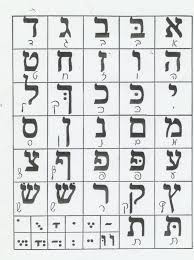 They got these aleph beis flip books that they adore and have sadly ripped apart one of, but they still play with it. A fellow homeschooler gave us a cloth book and they drag it to me constantly and asked to be quizzed.
On Shabbos morning, casually, in under an hour, Elazar blitzed through all the nekudos. He did each page until he got them all correct. I don't know how much he will retain. But I'll find out next time he brings me the book.
This reminds me of an article that a fellow homeschooler posted last week which I keep thinking about. It talks about the debate between whole word reading and phonics (We did phonics when I was a kid, and when I started teaching, whole word reading was in, and they've since gone back to phonics). When I taught Sarah, before I started unschooling, I used phonics. The question: Why is it that all readers who are allowed to learn to read at their choice, use whole word reading? But phonics is shown to be more efficient in the classroom? Another question: Why is it that in the classroom, teaching reading takes 3 years to achieve proficiency, but children who learn on their own, although the age range varies from 3 ("precocious readers") to 11, learn quite quickly (in weeks or months).
**warning: quote of extremist rhetoric*** but I keep thinking about it:
We seem to have acquired an array of aleph beis paraphernalia. I myself bought 3 puzzles that are used with medium to rare frequency, depending. (I'll admit I hid them a lot because these days it's more that they are dumped than that they are being used). My grandmother got them flash cards, I printed out something like this and hung it in a random high foot traffic area.
On Shabbos morning, casually, in under an hour, Elazar blitzed through all the nekudos. He did each page until he got them all correct. I don't know how much he will retain. But I'll find out next time he brings me the book.
This reminds me of an article that a fellow homeschooler posted last week which I keep thinking about. It talks about the debate between whole word reading and phonics (We did phonics when I was a kid, and when I started teaching, whole word reading was in, and they've since gone back to phonics). When I taught Sarah, before I started unschooling, I used phonics. The question: Why is it that all readers who are allowed to learn to read at their choice, use whole word reading? But phonics is shown to be more efficient in the classroom? Another question: Why is it that in the classroom, teaching reading takes 3 years to achieve proficiency, but children who learn on their own, although the age range varies from 3 ("precocious readers") to 11, learn quite quickly (in weeks or months).
**warning: quote of extremist rhetoric*** but I keep thinking about it:
While children out of school learn what and because they want to, children in school must learn or go through the motions of learning what the teacher wants them to learn in the way the teacher wants them to do it. The result is slow, tedious, shallow learning that is about procedure, not meaning, regardless of the teacher’s intent.
The classroom is all about training. Training is the process of getting reluctant organisms to do or learn what the trainer wants them to do or learn. Under those conditions, methods that focus on the mechanical processes underlying reading—the conversion of sights to sounds—work better than methods that attempt to promote reading through meaning..
Wednesday, November 20, 2013
resumption of sfatenu: Filling in Gaps
So, if you are a casual homeschooler who leans towards unschooling, you might wake up one day and realize you completely forgot that your 7th grader had agreed to work on her Ivrit and you haven't been doing anything like that for 5 months. You haven't done reading, writing, speaking, Sfasenu...
Whoops.
So I handed Chana the book this morning. With juggling rashis on top of Chumash, and now adding in serious math so she can be prepared for high school, and now Ivrit, that's a decent amount of work per day.
She needed my help reading the story. (She's towards the end of the 4th grade book. I would consider Ivrit one of the weaker parts of my homeschool.) Part of it is just that she needs to read it out loud, and once she did that, she understood a lot more. But the story is a bit tough.
One of the things I really like about homeschooling is probably something that gives new homeschoolers a lot of anxiety. I've been homeschooling for 15 years now, and even though periodically I wake up and realize I have dropped the ball on a particular subject or skill, it's really so very easy to just pick it up and incorporate it into the daily schedule and cover what needs to be covered, quickly and efficiently, in just a few months. That's why I don't really stress about writing skills or Ivrit (or math etc.). A few months of intensive focus with an older, motivated child can really fill in any gaps. In fact, I've stopped calling them "gaps" and started thinking of it as "learning when there is motivation and efficiency."
Whoops.
So I handed Chana the book this morning. With juggling rashis on top of Chumash, and now adding in serious math so she can be prepared for high school, and now Ivrit, that's a decent amount of work per day.
She needed my help reading the story. (She's towards the end of the 4th grade book. I would consider Ivrit one of the weaker parts of my homeschool.) Part of it is just that she needs to read it out loud, and once she did that, she understood a lot more. But the story is a bit tough.
One of the things I really like about homeschooling is probably something that gives new homeschoolers a lot of anxiety. I've been homeschooling for 15 years now, and even though periodically I wake up and realize I have dropped the ball on a particular subject or skill, it's really so very easy to just pick it up and incorporate it into the daily schedule and cover what needs to be covered, quickly and efficiently, in just a few months. That's why I don't really stress about writing skills or Ivrit (or math etc.). A few months of intensive focus with an older, motivated child can really fill in any gaps. In fact, I've stopped calling them "gaps" and started thinking of it as "learning when there is motivation and efficiency."
Wednesday, November 13, 2013
way of practicing ivrit conversation with older kids
Whew, I must have been wiped out last night! I came down and last night's blog post was accidentally still unpublished.
I read Orthodox Jewish educational message boards like Lookjed.
This is from mifgashim. It's the kind of idea that I think is terrific, but I probably won't do because I'm a lazy unschooler. But if my kids ever told me they wanted to beef up their Ivrit speaking skills, this is exactly the way I would create the lesson for them.
I read Orthodox Jewish educational message boards like Lookjed.
This is from mifgashim. It's the kind of idea that I think is terrific, but I probably won't do because I'm a lazy unschooler. But if my kids ever told me they wanted to beef up their Ivrit speaking skills, this is exactly the way I would create the lesson for them.
Increasing Hebrew conversation time in class
I've found a very easy idea for bringing conversational Hebrew into a classroom. The goal here is to create a natural and authentic experience of Hebrew conversation. I have a class of 11th and 12th graders in our evening program, but this would work well in a day school, too.
I begin with a list of conversation starters. You can get them from many sources: on line, board and card games, or, as I do, from an app called Table Topics. I've divided the class into groups of 5-6 students and posted a listed of group leaders and the questions for the two coming months.
This week's question was, What is more important, justice or mercy? Next week we will ask, Is your cup half full or half empty?
The leaders are responsible, not only for introducing the question, but for keeping the conversation moving through follow-up and probing questions. Each student has a slip of paper to give him/herself a grade. (I don't take those grades too seriously, but they do insure that students participate well.)
I do NOT participate or even sit with the students; I want the conversations to be natural and unmonitored. They usually last about 30 minutes. From across the room I can see that students are intensely engaged, laughing, arguing, looking surprised, telling interesting stories, interrupting each other, more concerned about communicating than about learning Hebrew — which is exactly what I want. The leaders and participants are highly motivated, and the students are very excited about the activities each week.
This part of the lesson is also very easy for a busy teacher to prepare.
Yosi Gordon
Basically, from what I understand, we would choose an interesting conversation starter. I think I would also write up a bunch of phrases on cards or on a paper that have to do with the topic or the main vocabulary words that have to do with the topic, so that the students can glance at them when they get stuck on a word or phrase.
This is the kind of lesson plan that has me daydreaming of going to my high school principal and asking to teach an Ivrit class, to see if a semester of conversational starters like this get the students more comfortable with speaking Hebrew. Then I think to myself that, hey, I homeschool, I can do this with my kids. But that takes a lot of preparation and I tend to be more fly-by-the-seat-of-my-pants type of homeschooler. But if any of you are more the type who prepare lessons, let me know how this works!
Tuesday, October 22, 2013
unschooling aleph beis writing
Elazar (age 6) came over to me with a blank piece of paper and a pen and said he wanted to write. He asked for aleph beis, not the alphabet. He said he didn't want "lowercase" (that's what he calls script). I said in Hebrew we only write script, we don't write print in Hebrew. So he agreed.
What was new about this activity is that I didn't write a whole row of "follow the dotted line." Up until now, I gave him dotted lines for every letter. This time, I just wrote the first letter dotted. He chose to copy the rest freehand. He didn't have that capacity the last time he sat down to write.
He did really nicely except he got a little confused in the middle of the gimels. (And as he was writing them incorrectly, he was saying, "I'm sooooo good at these gimels!" But alas). I told him it's a line and a C, and he did the next one correctly.
He was tickled that a Vav is just a straight line.

What was new about this activity is that I didn't write a whole row of "follow the dotted line." Up until now, I gave him dotted lines for every letter. This time, I just wrote the first letter dotted. He chose to copy the rest freehand. He didn't have that capacity the last time he sat down to write.
He did really nicely except he got a little confused in the middle of the gimels. (And as he was writing them incorrectly, he was saying, "I'm sooooo good at these gimels!" But alas). I told him it's a line and a C, and he did the next one correctly.
He was tickled that a Vav is just a straight line.

Monday, October 7, 2013
unschooling writing
Last night, before bed, Elazar pulled out a notebook and delightedly started writing lower case "i"s. Then he remembered about alephs (I skip hebrew print writing--we only do recognition/reading for hebrew print and when they want to write I teach script and say, "This is how we write Hebrew"), and did those. Then ב then ל, which he got a big kick out of.
I had actually been wondering why an unschooled child would ever write Hebrew. Chana doesn't write much Hebrew, even though I occasionally have her write a story for practice. Sarah's Hebrew writing was fairly dismal, though she caught up quickly when she went to school. But it seems that Elazar is motivated and perhaps will indeed eventually want to learn all the script letters and will practice them enough to write.
I had actually been wondering why an unschooled child would ever write Hebrew. Chana doesn't write much Hebrew, even though I occasionally have her write a story for practice. Sarah's Hebrew writing was fairly dismal, though she caught up quickly when she went to school. But it seems that Elazar is motivated and perhaps will indeed eventually want to learn all the script letters and will practice them enough to write.
Monday, September 2, 2013
Many people are concerned that allowing unlimited time on multimedia will cause children to become addicted.
- Based on the book Are You Hungry by Hirschmann and Zaphiropoulos, unlimited can lead to moderation.
- If the child is under stress, then dealing with the source of the stress (e.g. a troubled marriage or unhealthy parenting) is more fundamental than multimedia time.
- If real life has interesting, hands-on opportunities to explore things, then children will generally prefer that to spending all of their time on multimedia, if given a genuine choice between unlimited multimedia and doing fun things. (And if the emotional stresses are resolved.)
But that's not why I'm here today. That was just the intro. My daughter has a facebook page. The rules are to only accept friends she knows in real life. (An exception is a girl she met online and whom we have met on facetime or whatever app it is these days after asking her to get her mother's permission, and are thus convinced she is who she says she is.)
Whoops, I'm getting distracted. This is not a post on my multimedia policies for preteens. Educate yourself and be smart. (My personal refrain to my daughter is: "Assume the person you are talking to might be a 30 year old pedophile.")
What I wanted to say is that facebook chat has been nice for unschooling Ivrit. I speak (halting American) Hebrew to my kids. When writing Chana a note, it's been more complicated because she isn't nearly as good at reading as she is at listening comprehension. The first thing I did when she got her computer and her ipad (both earned herself) was put Hebrew language on. With gchat, I used to type in Hebrew, too, but I'm just finding with fb chat that she understands me better and is even trying to type Hebrew when she can. Maybe because she is older now.
- Based on the book Are You Hungry by Hirschmann and Zaphiropoulos, unlimited can lead to moderation.
- If the child is under stress, then dealing with the source of the stress (e.g. a troubled marriage or unhealthy parenting) is more fundamental than multimedia time.
- If real life has interesting, hands-on opportunities to explore things, then children will generally prefer that to spending all of their time on multimedia, if given a genuine choice between unlimited multimedia and doing fun things. (And if the emotional stresses are resolved.)
But that's not why I'm here today. That was just the intro. My daughter has a facebook page. The rules are to only accept friends she knows in real life. (An exception is a girl she met online and whom we have met on facetime or whatever app it is these days after asking her to get her mother's permission, and are thus convinced she is who she says she is.)
Whoops, I'm getting distracted. This is not a post on my multimedia policies for preteens. Educate yourself and be smart. (My personal refrain to my daughter is: "Assume the person you are talking to might be a 30 year old pedophile.")
What I wanted to say is that facebook chat has been nice for unschooling Ivrit. I speak (halting American) Hebrew to my kids. When writing Chana a note, it's been more complicated because she isn't nearly as good at reading as she is at listening comprehension. The first thing I did when she got her computer and her ipad (both earned herself) was put Hebrew language on. With gchat, I used to type in Hebrew, too, but I'm just finding with fb chat that she understands me better and is even trying to type Hebrew when she can. Maybe because she is older now.
Tuesday, July 9, 2013
it's not as bad as i thought
I went through the part in the siddur that Chana didn't understand with her. When I saw it, I understood why she had trouble reading it. It was a long, sophisticated paragraph explaining when to take the 3 steps back and when to bow. I wonder if I would have had trouble with it even in high school.
Chana is on page 68 out of 94 pages of 4th grade Sfasenu (remember, in 6th grade she did the 3rd grade one as per "the three years ahead" rule and then she moved on to the 4th grade one). I'm trying to decide what to do next with her. Ivrit Shitatit? (We used that in 7th and 8th grade and shortened its name derogatorily.) I have one of them but I'm not sure if it's the first one, or if that matters.
Another possibility I was thinking of is to have her read picture books. I have a fair collection of Hebrew picture books bought from Israel. Some of them are pretty sophisticated. Meaning they have words I don't understand ;-) They are all elementary school age books. I myself am not comfortable reading novels in Hebrew. I could probably slog through it, but it would be slow. Anyway, they probably won't be too painful and should make for some nice reading comprehension. But we have some time before the next step. Probably after Succos.
Chana is on page 68 out of 94 pages of 4th grade Sfasenu (remember, in 6th grade she did the 3rd grade one as per "the three years ahead" rule and then she moved on to the 4th grade one). I'm trying to decide what to do next with her. Ivrit Shitatit? (We used that in 7th and 8th grade and shortened its name derogatorily.) I have one of them but I'm not sure if it's the first one, or if that matters.
Another possibility I was thinking of is to have her read picture books. I have a fair collection of Hebrew picture books bought from Israel. Some of them are pretty sophisticated. Meaning they have words I don't understand ;-) They are all elementary school age books. I myself am not comfortable reading novels in Hebrew. I could probably slog through it, but it would be slow. Anyway, they probably won't be too painful and should make for some nice reading comprehension. But we have some time before the next step. Probably after Succos.
Tuesday, July 2, 2013
kol hatchalot enthusiasticot
I handed chana a piece of paper with 3 things written (in hebrew)
1. write hebrew story (est 20 min)
2. chumash (20 min)
3. shemona esrei (est 15 min)
I asked her to please fill out times when she planned to do those activities. she made a 12 next to the first one, a 1 next to the 2nd, and a "after my plans" next to the 3rd. she drew a neutral face next to the story, an unhappy face next to chumash, and a rejoicing face next to "plans."
At ten minutes to 12, she got a notebook and writing utensil. I told her to take her ipad to look up words she didn't know. She had to re-download the translator app, which she apparently deleted due to lack of use. She told me to say, "Class, you may begin," at precisely 12. I don't know what she did for those last few minutes. Thought of ideas? Tried out the app? At 12, she reminded me to say it, so I did.
After 12 minutes, she asked if she could stop. She had written almost 3/4 of a page in small letters. So I said yes. I said tomorrow I would check it with her, and we would correct the first draft together.
Now, even though it is 12:30 and not 1, she is doing Chumash. 12:40, and we finished. Chazara of half of sheni, chazara of the 2 (complicated) pesukim we did yesterday, and 3 new pesukim.
I predict that since the 3rd time was vague and not specific, she will not initiate it. But we shall see.
We shall also see if I have the oomph to keep up with this and follow through. Tomorrow the story draft, and today shemona esrei translation.
1. write hebrew story (est 20 min)
2. chumash (20 min)
3. shemona esrei (est 15 min)
I asked her to please fill out times when she planned to do those activities. she made a 12 next to the first one, a 1 next to the 2nd, and a "after my plans" next to the 3rd. she drew a neutral face next to the story, an unhappy face next to chumash, and a rejoicing face next to "plans."
At ten minutes to 12, she got a notebook and writing utensil. I told her to take her ipad to look up words she didn't know. She had to re-download the translator app, which she apparently deleted due to lack of use. She told me to say, "Class, you may begin," at precisely 12. I don't know what she did for those last few minutes. Thought of ideas? Tried out the app? At 12, she reminded me to say it, so I did.
After 12 minutes, she asked if she could stop. She had written almost 3/4 of a page in small letters. So I said yes. I said tomorrow I would check it with her, and we would correct the first draft together.
Now, even though it is 12:30 and not 1, she is doing Chumash. 12:40, and we finished. Chazara of half of sheni, chazara of the 2 (complicated) pesukim we did yesterday, and 3 new pesukim.
I predict that since the 3rd time was vague and not specific, she will not initiate it. But we shall see.
We shall also see if I have the oomph to keep up with this and follow through. Tomorrow the story draft, and today shemona esrei translation.
ivrit fail
I had been planning for Chana to write a short story in Ivrit, where she looks up words that she wants to use and I go over it afterwards, edit the grammar, she does a rewrite, does more than one draft, and at the end, has a polished story.
We never got around to it.
We are in the middle of shemona esrei translation, and that kind of fizzled out.
Chana told me that she was davening from a siddur at my parents' house, and the instructions were in Hebrew and she didn't understand them. She's going into 7th grade, and apparently either she can't read without nekudos or she is intimidated to try.
Time to take a look at Ivrit and see if we need to do some work.
This morning (it's always a challenge to bring up work to Chana in the morning--I've mentioned many times that she prefers to work at night) I reminded her that she agreed to do the story. She agreed that she had agreed. I also said over the weekend, when we are back at my parents, I'd like to go through the shemona esrei and look at the instructions with her and help her read and understand them. She scowled, but agreed. After all, she herself was not happy that she didn't understand them.
A few minutes later when I brought up that we hadn't finished translating shemona esrei, she had enough.
As it is, we have to agree on when to do Chumash today. I think I will wait a half an hour (unfortunate, since it's pretty quiet now, as Jack and Elazar are playing outside with the neighbors), then ask her when she would like to schedule 3 activities today: beginning her story, chumash, and translation of another bracha of shemona esrei (or a quick review of the ones we already did).
And I just realized it's been over a week of no sfasenu. Yeesh.
We never got around to it.
We are in the middle of shemona esrei translation, and that kind of fizzled out.
Chana told me that she was davening from a siddur at my parents' house, and the instructions were in Hebrew and she didn't understand them. She's going into 7th grade, and apparently either she can't read without nekudos or she is intimidated to try.
Time to take a look at Ivrit and see if we need to do some work.
This morning (it's always a challenge to bring up work to Chana in the morning--I've mentioned many times that she prefers to work at night) I reminded her that she agreed to do the story. She agreed that she had agreed. I also said over the weekend, when we are back at my parents, I'd like to go through the shemona esrei and look at the instructions with her and help her read and understand them. She scowled, but agreed. After all, she herself was not happy that she didn't understand them.
A few minutes later when I brought up that we hadn't finished translating shemona esrei, she had enough.
As it is, we have to agree on when to do Chumash today. I think I will wait a half an hour (unfortunate, since it's pretty quiet now, as Jack and Elazar are playing outside with the neighbors), then ask her when she would like to schedule 3 activities today: beginning her story, chumash, and translation of another bracha of shemona esrei (or a quick review of the ones we already did).
And I just realized it's been over a week of no sfasenu. Yeesh.
Monday, June 10, 2013
mizbeach
I sat with the artscroll rashi book open today. But that wasn't nearly enough. I'm google imaging right and left.
http://www.utom.org/library/pictures/tabernacle/copperalter2.jpg
That's the picture that I found most useful. My favorite is that it labeled all the different weird Hebrew words like border and netting. I did this with Sarah and I don't recall a lattice netting. (google "lattice" for Chana, but then I ended up pointing to our radiator cover that also has a metal lattice.) Guess I learn something new each time.
I did peruse rashi in English to discover what it means to put something under from the bottom. Superfluous and saying the same thing twice. Chana wanted to know why.
PS. Chana had her bas mitzva and we still haven't finished all the meanings of the brachos in shemona esrei (though she can fulfil her technical chiyuv of tefila without it).
PPS. I had been wanting Chana to work on writing Ivrit and I told her to come up with an idea for a story but so far that's all we did.
PPPS. I'm not impressed with Sfasenu 4. It's getting that I pretty much need to sit next to her when she reads it and I'm not sure she's actually improving in her Hebrew.
http://www.utom.org/library/pictures/tabernacle/copperalter2.jpg
That's the picture that I found most useful. My favorite is that it labeled all the different weird Hebrew words like border and netting. I did this with Sarah and I don't recall a lattice netting. (google "lattice" for Chana, but then I ended up pointing to our radiator cover that also has a metal lattice.) Guess I learn something new each time.
I did peruse rashi in English to discover what it means to put something under from the bottom. Superfluous and saying the same thing twice. Chana wanted to know why.
PS. Chana had her bas mitzva and we still haven't finished all the meanings of the brachos in shemona esrei (though she can fulfil her technical chiyuv of tefila without it).
PPS. I had been wanting Chana to work on writing Ivrit and I told her to come up with an idea for a story but so far that's all we did.
PPPS. I'm not impressed with Sfasenu 4. It's getting that I pretty much need to sit next to her when she reads it and I'm not sure she's actually improving in her Hebrew.
Subscribe to:
Posts (Atom)

